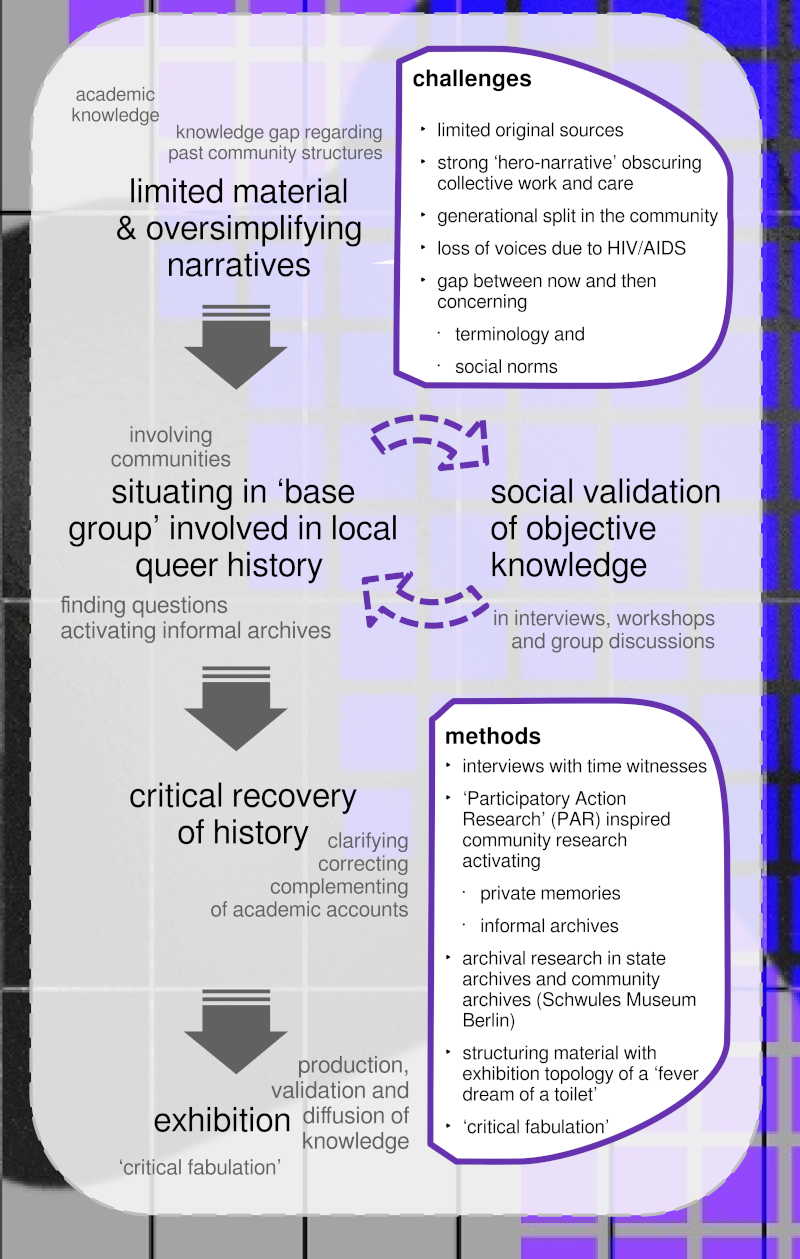
The challenges posed by the project stemmed primarily from the bias inherent in state archives, as well as from the lack of visibility of activist perspectives due to repression, the lack of institutionalisation of community archives, and the very nature of counterculture itself.The project addresses these challenges by combining scientific and participatory methods. The latter include interviews with eyewitnesses*, community workshops and other forms of community work designed to draw on and activate personal memories and informal archives. This form of community-based research also enables the social validation of objective knowledge.
This artistic research gave rise to an exhibition that brought together community-based and academic knowledge, presenting both within a shared exhibition framework. Existing gaps in the material, as well as contradictions in the narratives found regarding the original interventions, were addressed through critical fabulation.
Archival Research
Historical research to date has relied exclusively on police and official archive documents and, as such, has been able to identify only the visible protagonists – an openly gay theatre director and a prominent figure in the local gay rights movement – as holding activist positions. This perspective rendered other activists invisible, as they had to remain anonymous to protect themselves from repression, such as losing their jobs. Consequently, the story was reduced to a heroic narrative, obscuring the collective work and care, as well as the necessary infrastructure – such as shared meeting places, groups, their artistic strategies and motivations. The research project expands on the ‘hero’s narrative’ by combining historical research with an artistic exploration of the activists, their groups, their stories and their meeting places.
Challenges following archival research
- limited original sources
- a strong ‘hero narrative’ that obscures collective work and care
- lack of intergenerational contact within the community
- loss of voices due to the HIV/AIDS crisis
- gap between today (2026) and 1980 regarding
- terminology and
- social norms
Participatory Research
Starting from a situation with limited original material, and oversimplified narratives, the first step was to involve the community. Situating the research in a ‘base group’ involved in local queer history (Queer History Month Hamburg) helped with bridging the gap between then and now. This research was conducted by building a network of time-wittnesses, community elders and queer history embassadors. Exploring the case study together sorted the material, the story and its inconsistencies, and —most importantly– the gaps in the narrative fabric. Intense discussions in this network revealed useful questions and vectors to produce meaning and potential.
Personal Memory
Within the base group, a number of individual biographical interviews and expert interviews were conducted, which were analysed in consultation with members of the group. Formal and informal group discussions supplemented the interviews with the participants’ individual recollections. It was also possible to analyse interviews that had been conducted in the past by individual members of the grassroots group with activists, some of whom have since passed away.
Informal Archives
Involving the community also activated informal archives, such as forgotten boxes in someone’s attic, a private photo album, personal stories never considered interesting before.
Social Validation of Knowledge
A third function of situation the research in a ‘base group’ is the social validation of produced knowledge. Expert interviews and biografical interviews, workshops, and group discussions created a frame to triangulate predicates in testimonies. This helped in navigating historic uncertainties and in mapping the historic terrain. Aim of this endeavor is a critical recovery of history by clarifying, correcting, and complementing the academic acounts of the case study “Hamburger Spiegelaffäre”.
The Exhibition
The final step of the research was the production of the performative installation »Hammerschlag« in April 2026 in Kampnagel theatre Hamburg.
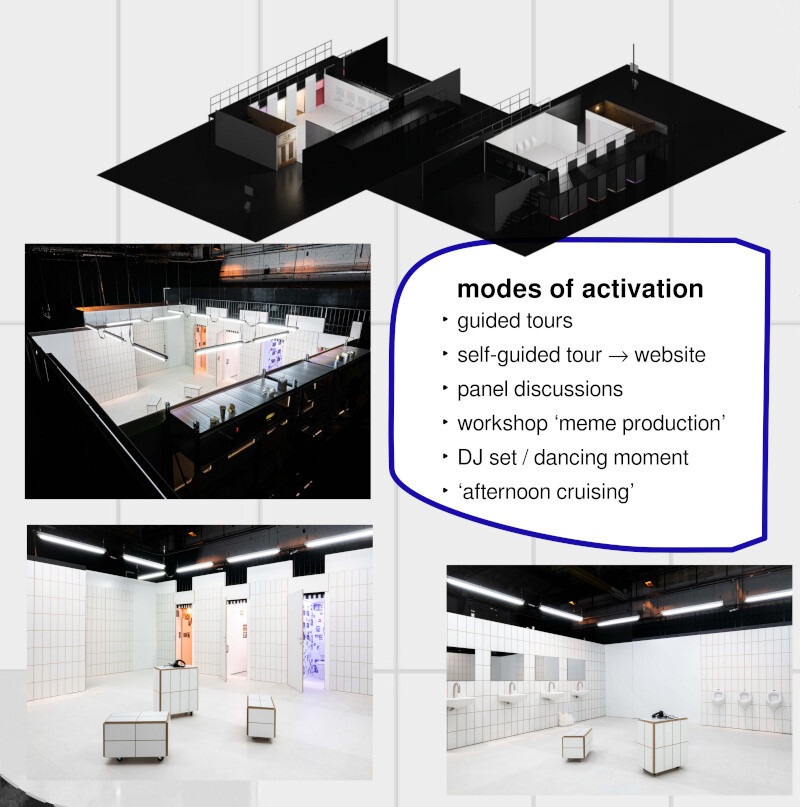
After bridging the gaps in terminology and living situation between then and now, the exhibition physically re-imagines a ‘fever dream of a public toilet’ and tells the story of self-emancipation of queer activists from state oppression. How did activist shape public discourse? How did they organise as a collective? What narratives did they use? Also: how was the genesis of state sponsored surveillance of gay people? Photographs, articles, interviews, and videos, were allocated in the toilet stalls, showing where, how, and in which structures gay counter culture was happening.
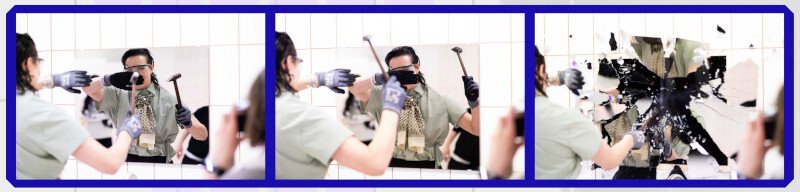
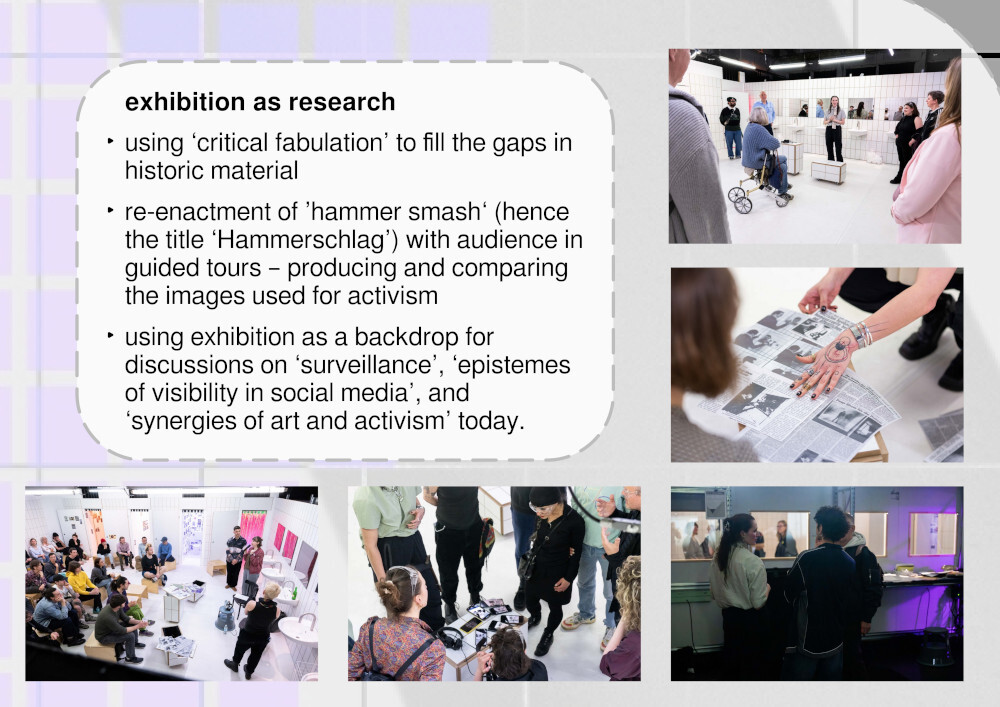
Guided tours re-enact the production of images, and lure the audience into the logics of identity and observation, intimacy and political identity, community and activism.
Critical Fabulation
The artistic development of this collective memory space heavily relied on what Saidiya Hartman calls ‘critical fabulation’. She suggests that it makes more sense to carve out and highlight the very gaps in the archive, and make visible what’s lost and uncertain, instead of filling the voids of the archival process and manufacture a smooth narrative. Overwriting the rim of knowledge would obscure its own means of production and make a critical recovery of the humans behind history impossible. Even if done with the best intentions, this action would defacilitate epistemic justice. Therefore a core gesture of the exhibition was not only to show as much archival material as possible, but also underline the blind spots of the archives, how it was created, and what is missing.
This methodological premise lead to a whole string of other artistic considerations, for instance, the developement of the “fever dream of a public toilet” as an exhibition topology. This was chosen due to both the impossibility to find an accurate floorplan of any pf the public toilets with built in one-way-mirrors, and the lack of an ‘original’ site of activism. In 1980 not just one of the existing ten spy mirrors have been smashed, but several of them. Structuring the material along this admittedly virtual –if not purposely delusional– layout reinforces the imaginative and malleable nature of narratives and historic accounts.