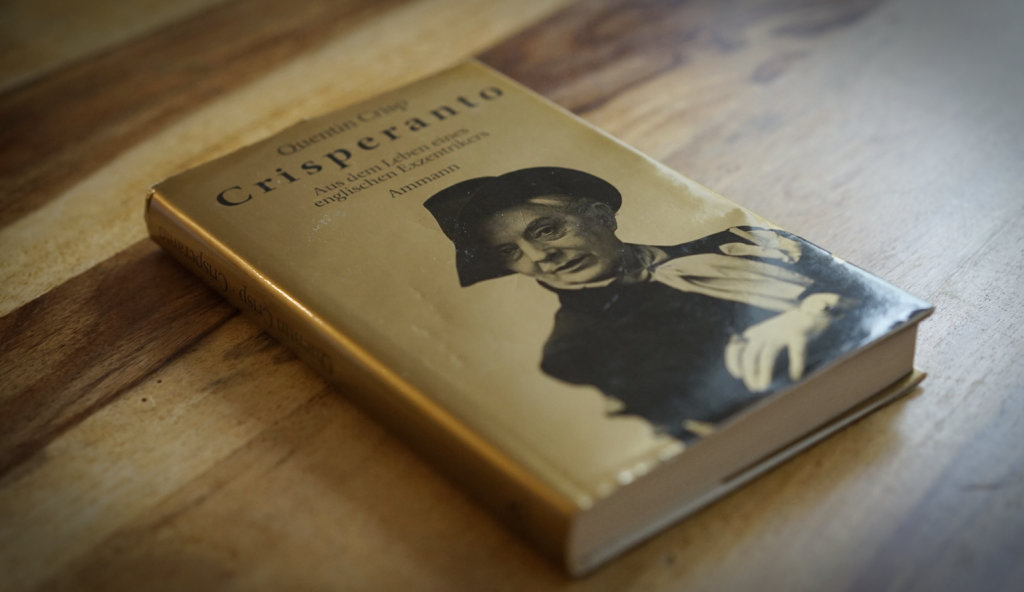
The British gay eccentric Quentin Crisp writes the following about police decoys in public restrooms in his 1968 book The Naked Civil Servant (translated into German in 1988 as Crisperanto):
CW: racist stereotypes, the N-word
The main area of operation for this particular strategy was the dimly lit public restrooms in the less densely populated areas of London. While a plainclothes detective paced back and forth across the street with watchful indifference, his accomplice—selected by superiors for his natural, job-appropriate physique—stood there at the urinal and “showed off”—he displayed his DIY apparatus to anyone who happened to walk in. (One cannot imagine what an equipment inspection—which would, after all, have to take place before every shift—would look like.) The trap worked well, and many of the most unbelievable people were lured to their doom in this manner. More recently, now that everyone is familiar with these maneuvers, they have fallen out of fashion. Common knowledge robs them of their effect. They also offend the sporting instinct of the British people. They are seen as a trick, like placing a diamond bracelet on the sidewalk and pouncing from ambush on anyone who bends down to pick it up. Almost exclusively, it was borderline cases that were caught. Those whose idea of a pleasant evening consisted of wandering from one “gentleman” to another quickly learned to recognize a cop even by touch. People who had never heard of homosexuality but whose natural curiosity was aroused by any manifestation of strange human behavior were put in such danger by these police techniques. Even if you had a good night, asking the officer what on earth he was doing there would certainly lead to arrest; if it was a bad night, a brief glance in his direction was enough. The worst consequence of the decoy system , however, was that for a police officer assigned to such a post who happened to have no sympathy for gay men, aversion quickly turned into the most savage hatred. Conversely, gay men who originally feared the police—which some might consider a good thing—now developed contempt for them.
From the perspective of the law, the only weakness of the decoy system was the fact that it took two police officers to catch a sex offender. That was a waste of manpower. The police viewed homosexuals the way the Native Americans viewed bison. They racked their brains over how to exterminate them in herds. With the help of informants, they found out where the big gay parties were held, and that’s where they focused their attention."
– Quentin Crisp: “Crisperanto,” Amman Verlag 1988, p. 96ff.