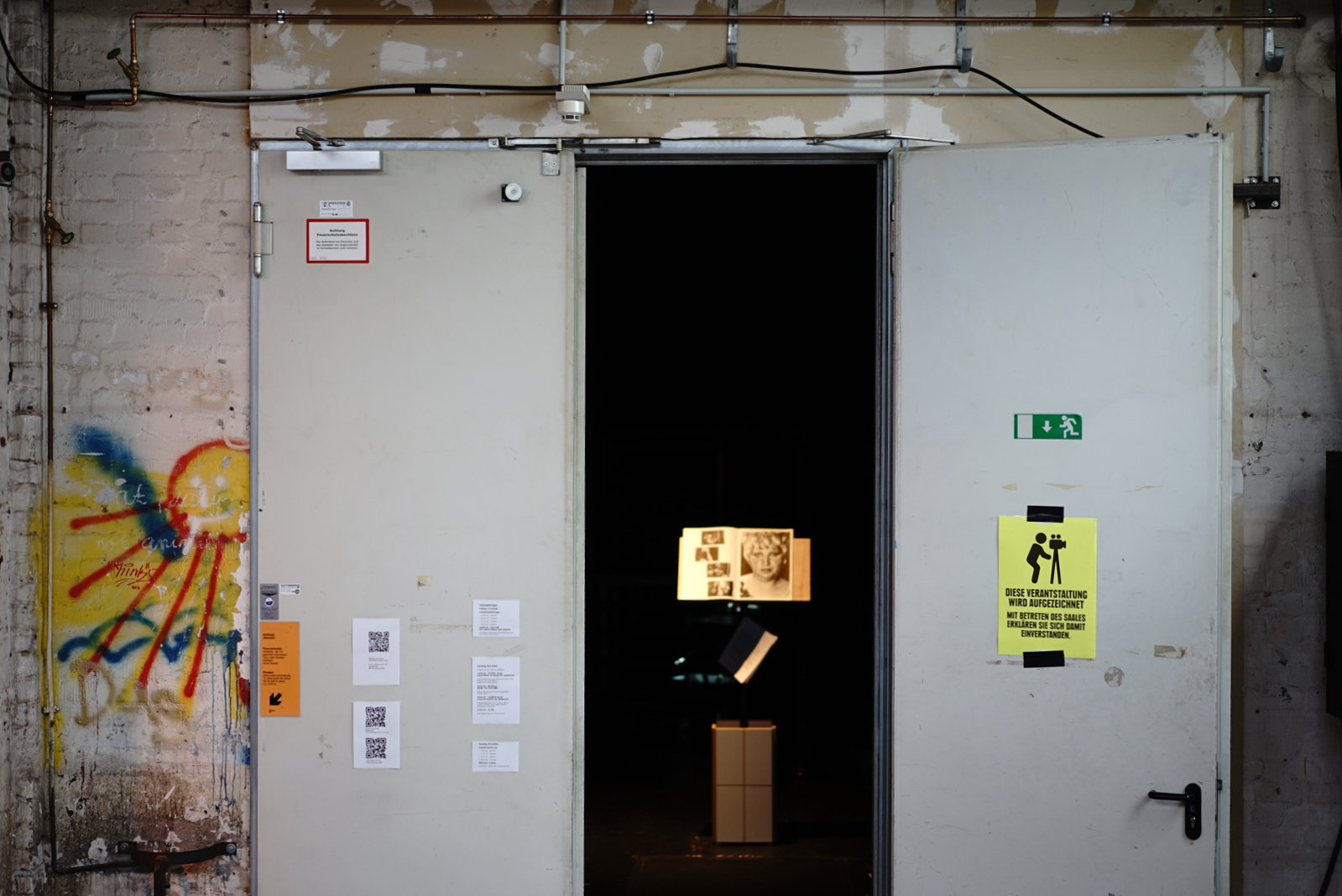
Welcome to the exhibition HAMMERSCHLAG about the “Hamburg Mirror Affair,” a campaign that led to the abolition of surveillance of gay men in public restrooms in Hamburg in 1980. On July 2, 1980, an anonymous collective smashed a spy mirror that had been installed in the public men’s restroom at the Jungfernstieg subway station. The Hamburg police had used this mirror to monitor men seeking sex with men and to illegally register them in so-called “Pink Lists” through checks, warnings, and bans from the premises.
The exhibition HAMMERSCHLAG explores police surveillance practices, the restroom space in queer art, and queer self-liberation practices in 1980. It thus traces the development of police surveillance in public restrooms in Hamburg, tells the story of queer resistance, and contextualizes these events within the broader historical landscape of the Federal Republic of Germany in the late 1970s. This text is intended to allow visitors to explore the installation and its stations on their own. In doing so, it will focus heavily on “uncovering” and “concealing,” on becoming “visible” and “invisible.” Some things will be brightly lit, while others will remain hidden.
The exhibition is an invitation to witness how a clandestine police practice became a public scandal through a concrete intervention—an act of political resistance.
Before we explore the main scene of that scandal, the restroom at Hamburg’s Jungfernstieg, we now enter the “antechamber,” a passageway designed to prepare us for this journey through time. Everything is at the beginning. The urinals are a bit too close together.