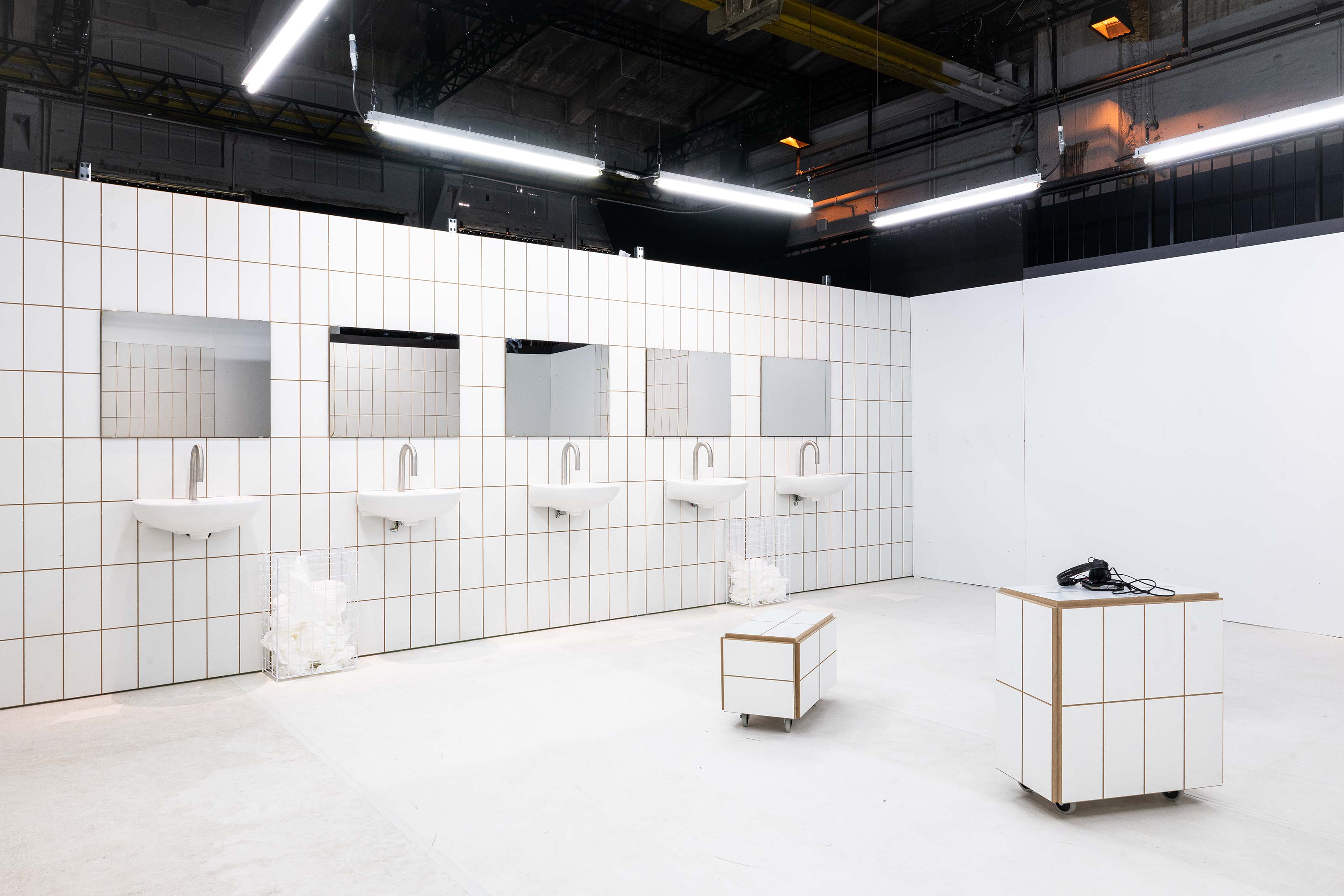
On July 2, 1980, the mirrors in the men’s restroom at Jungfernstieg—behind which observation rooms were located—were smashed in a media-effective display. Prior to this, during a gay and lesbian demonstration, evidence was presented that the police were maintaining files on homosexuals, thereby continuing—or at least reviving—the practice of the so-called “Pink Lists” from the Nazi era.
The sequence of events: As part of Hamburg’s first “Gay Pride Week,” the first lesbian and gay demonstration took place in the Hanseatic city on June 28, 1980. Under the slogan “10 Years of Stonewall – Against the Oppression of Homosexuals,” 1,500 participants marched from Hansaplatz through the city center and ended with a picnic in Schanzenpark. Even during the demonstration, a VW van had attracted attention; it now approached the demonstrators in Schanzenpark, and photographs were taken from inside through rolled-down windows. When confronted, the photographer—a plainclothes police officer—stated that the photos would be used to update the police files. The demonstrators, enraged by this, demanded the handover of the film and blocked the VW van. A squad of a hundred police officers called to the scene broke up the demonstration using Chemical Mace . Kai Reinecke recounts more about this moment in an eyewitness interview.
To counter the now-documented surveillance practices, anonymous activists smashed the first surveillance mirror at Spielbudenplatz on the night of June 29–30. The mirror action was repeated on July 2 in the presence of the press—Corny Littmann, an openly gay theater producer and then-lead candidate of the Hamburg Greens for the 1980 federal election, volunteered to be the face of the action, as he had less to fear from repression than his comrades.
Subsequently, activists compiled a documentation of the events, including a press review, under the title “Homosexuelle Bespitzelt” (Homosexuals Under Surveillance), which was publicly distributed at another demonstration with at least 250 participants on July 11 in the city center. Following the demonstration, a Rosa-Listen tribunal was also held in the main auditorium of the University of Hamburg.
The seating area contains documents and photos of the demonstrations, as well as documents detailing the sequence of events.
In addition to the historical context, we will examine further factors in the following sections that contributed to the success of such an action.