The TucTuc café at Oelkersallee 5 was founded in 1979 as a collective bar for the second German gay rights movement. As a self-organized space with a regular program of events, it was an important meeting place for the scene: many artists, including such well-known names as Rosa von Praunheim, Nina Hagen, Corny Littmann, Gunther Schmidt, Dieter Rita Scholl, Ernie Reinhardt, and Felix Rexhausen, organized readings, film screenings, and concerts here, exchanged ideas, and were able to experiment. The monthly Saturday disco, which took place at the TucTuc in rotation with the women’s bar, was a magnet for interesting people beyond the regular clientele.
On the upper floor was a meeting room where political gay groups such as “Schwusel” or “HAH” gathered. The “Stonewall” demonstration on June 28, 1980, as well as the demonstrations against the “Rosa Lists” on July 11, were likely planned here. As a political venue, the TucTuc had a major influence on the new organizations founded in the 1980s and 1990s; today’s institutions such as the mhc, the Café Gnosa , and the Schmidt Theater are just a few of them. Despite constant financial struggles and high turnover within the collective, the TucTuc remained open until 1995.
Ulrich Würdemann writes in 2mecs.de about the TucTuc, noting that it was “the first gay café without a doorbell and without darkened or covered windows, but rather fully visible,” and furthermore “a non-commercial venue that, beyond consumption and fun, offered space for politics and experiments of all kinds.” In an interview, Corny Littmann confirms its character as a creative playground. Here, many things could be tried out quite easily, with even unfinished works making it onto the stage.
As an example of some of the plays performed at the TucTuc, we can cite the sketch “What Is Homosexuality (1981)” by the group “Transitiv,” consisting of Claus Plänkers, Rita Dieter Scholl, and Ernie Reinhard. Another original video from the TucTuc is the SR documentary “Let’s Live Our Lives. Gay Men and Their Songs”, in which members of various theater and music groups in Hamburg’s gay scene around the café have their say and also discuss the founding of the TucTuc.
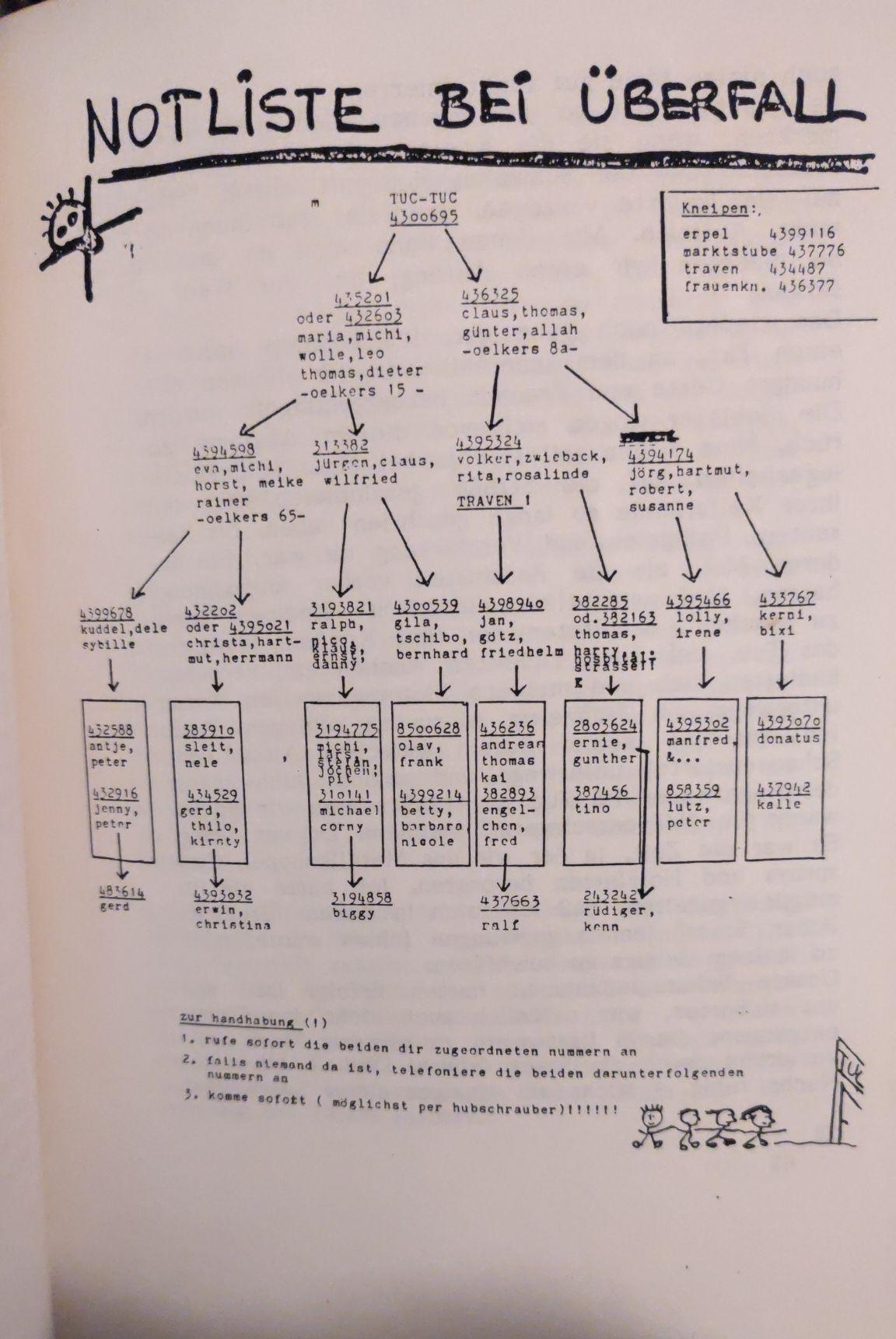
A glance at the hostile attacks makes it clear that the TucTuc, as a utopian space, could by no means exist “just like that,” but had to be not only rescued from the brink but also kept afloat through a collective effort. In the first four months alone, it was attacked at least five times by gangs described by eyewitnesses as “teenagers,” “bikers,” or “neo-fascists.” To protect against such attacks, a telephone chain was established, demonstrating a close-knit network of supporters in the surrounding community.