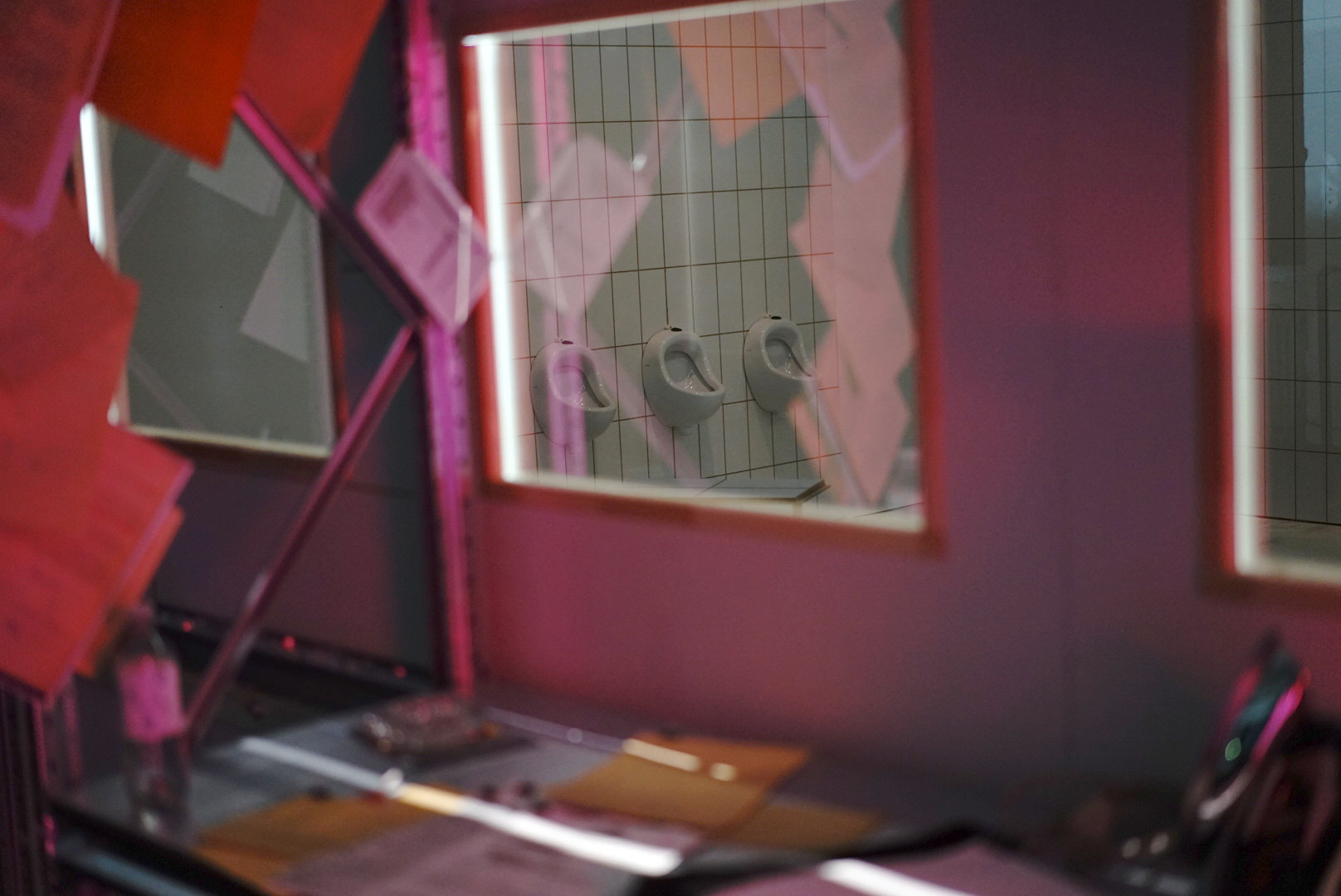
Surveillance in Hamburg restrooms can be traced back to August 1960, when the district office instructed the criminal investigation department to monitor the long line for homosexual activity, citing the protection of minors as the reason. Although the criminal investigation department did not observe any activity in the restrooms and could not confirm any danger to minors, surveillance continued.
There are surveillance logs from the Youth Protection Unit, which monitored bars, meeting places, and restrooms. Due to the conspicuous presence of the officers, monitoring the restrooms proved difficult, which is why, starting in 1964, existing restrooms were equipped with spy mirrors offering a view of the urinals, such as those at Spielbudenplatz or Großneumarkt. This allowed officers to monitor restroom users unrecognized, check on users behaving “suspiciously,” and record their personal details.
Starting in 1966, some newly constructed restrooms—such as those at Jungfernstieg (U2) in 1973 or at Rathausmarkt (S-Bahn) in 1974—were planned with built-in mirrors and observation chambers. In total, ten men’s restrooms were equipped with mirror systems by 1975.
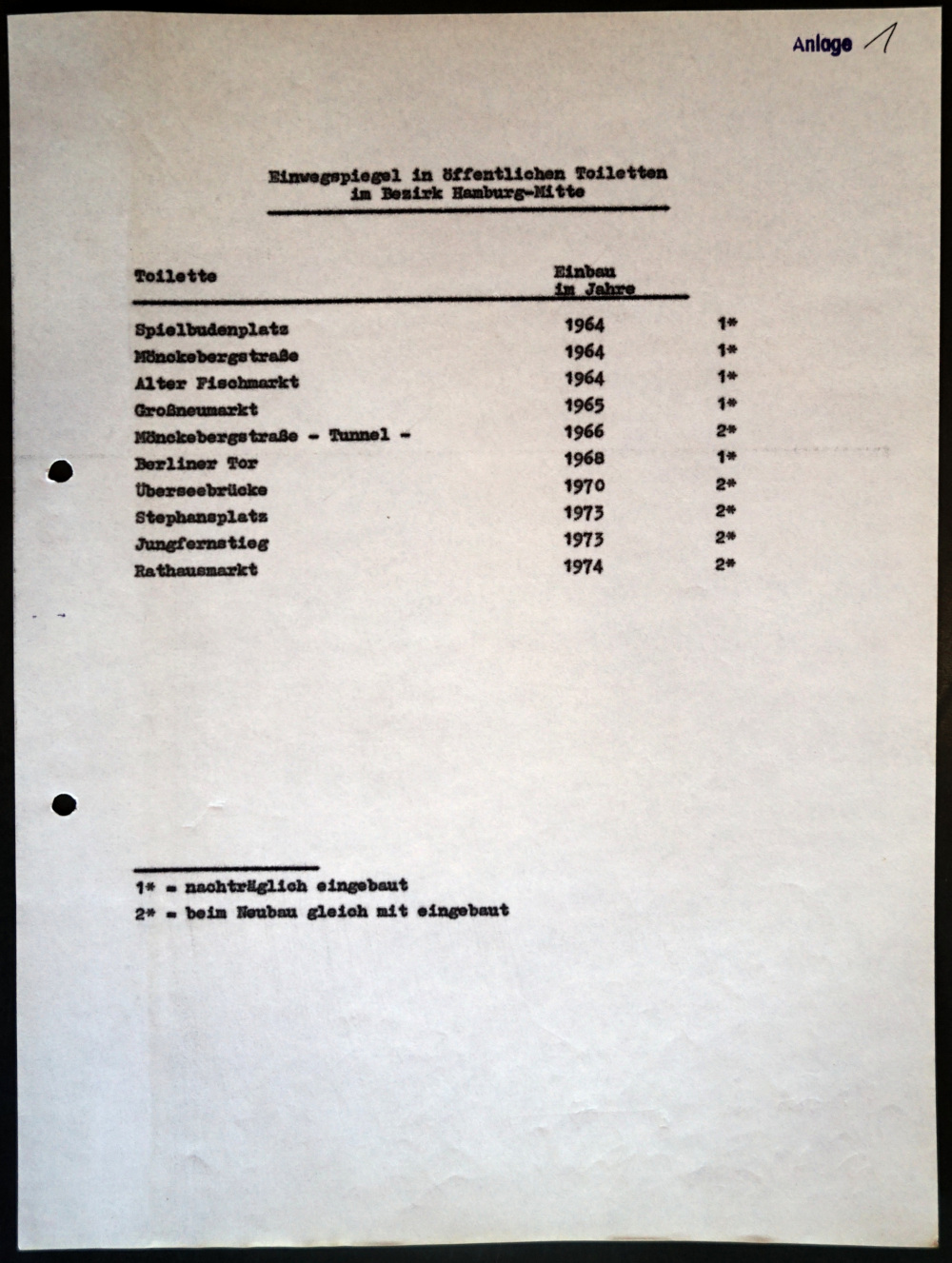
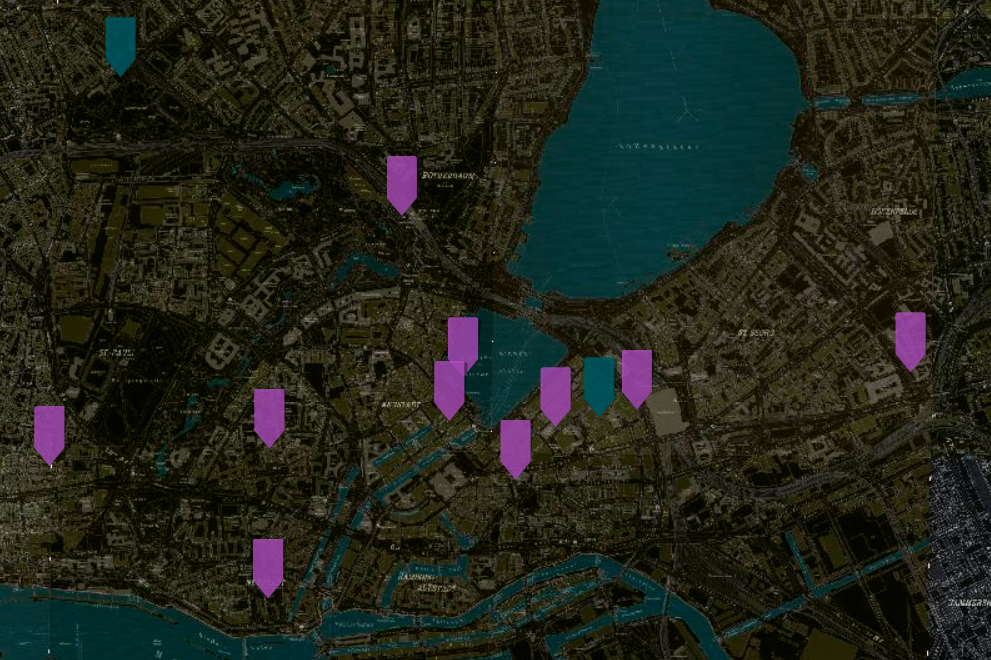
It was standard practice to issue a warning to “suspicious” users during an inspection, a measure that applied to all ten restroom facilities. If the individual were to behave “conspicuously” again at one of the ten specified restrooms and use them “inappropriately,” they would be barred from entering those very same ten restrooms. In the event of a further “inappropriate presence” within one of the ten restroom facilities, a criminal complaint for violating the ban would be filed. The stated goal of all three escalation levels of warnings and bans was deterrence. The police themselves note in their documents that the “conspicuous” behavior did not diminish, but at most shifted. Another objective, which was not officially noted due to its illegality, was the collection of personal data on men who had sex with men. As the Senate confirmed in retrospect, the names, addresses, and dates of birth of the men who were checked were entered into the Police Information System (POLAS), which could also be described as maintaining a homosexual registry.
In 1975, the Wandsbek Police Department also discussed installing a mirror system in the restroom facilities at Wandsbek Markt, as many men had been driven there by the surveillance in the city center. However, the installation of the mirrors was never carried out. Police authorities in other major German cities were also interested in mirror surveillance but ultimately decided against it as well, which is why the surveillance in Hamburg–Mitte—in this architectural form—is a unique case.